Wake Coach
Your squad's launch on one screen — split, rate and position, live from each crew's own phone. No unit to rig, nothing to hand out. And nobody writes anything down: by the time the trailer is loaded, the practice is already the record.
Free to start One squad, up to 12 athletes — no card, no trial clock.
What a program runs on today
The lineup is on a whiteboard by the bay door, and a photo of it is in the group chat. The workout is on a separate sheet. The splits are called across the water and written on a wet page. The erg scores go on a second whiteboard. The season's record is a spreadsheet somebody meant to type up in November.
None of them know about each other, and the one that gets skipped is always the same one — the record. It is also the one you want in March, when you are picking a boat.
Wake is not a sixth thing. It is one object, the practice. You write it down once, it carries the day, and it keeps the record afterwards. Nobody transcribes anything, because there was never a second copy to transcribe.
Before the session
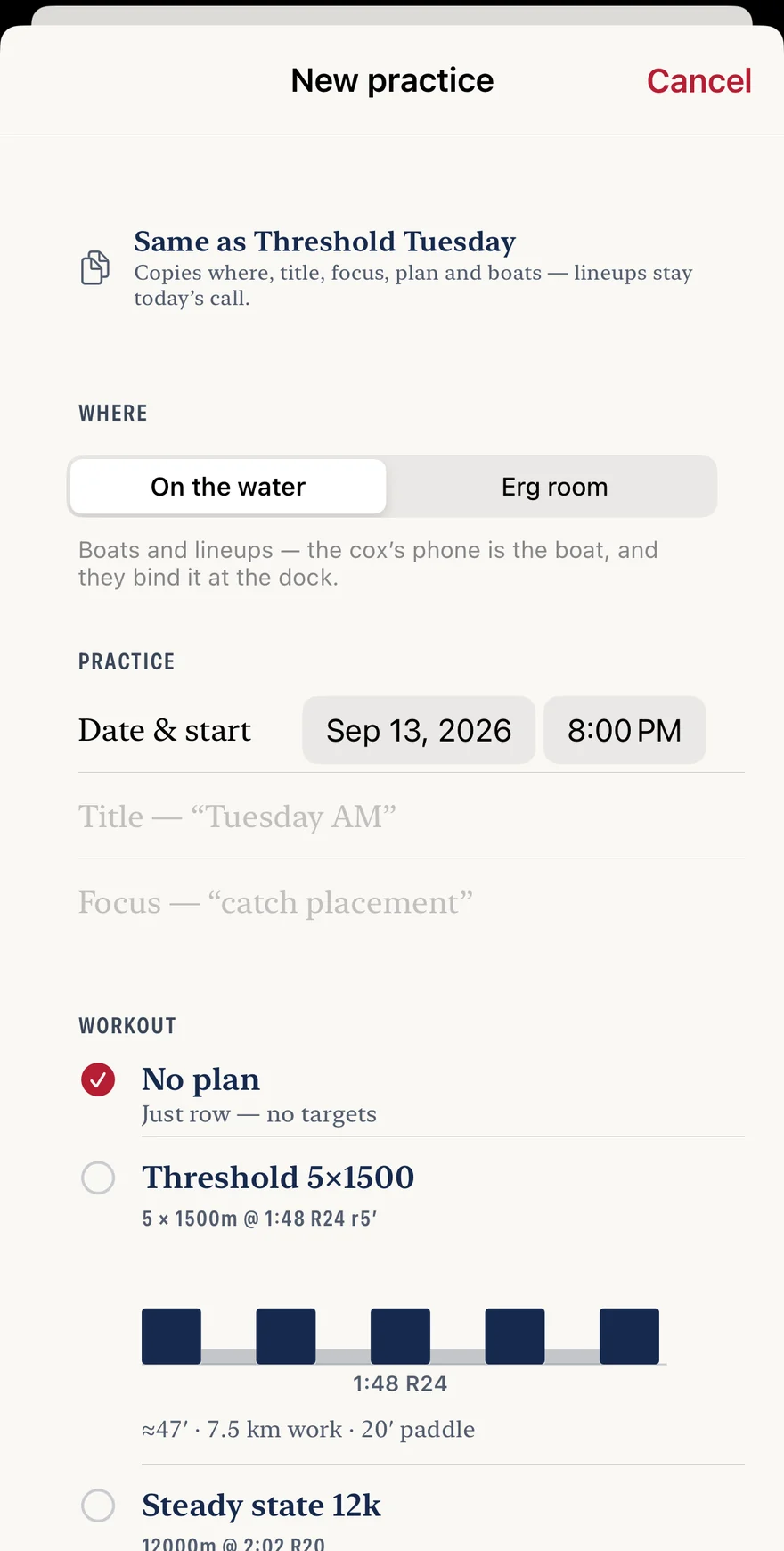
Type 5×1500m @ 1:48 R24 r5' and it becomes a session: pieces, split targets, rate caps, rests. R24 is a rate and r5' is a rest, and Wake reads them the way you wrote them — 4', 1:30, 90", 1500m and 1.5k all land as themselves.
Say where it happens — on the water or in the erg room — and the same object works either way. Then put the shells out, say which seat carries each boat's phone, and seat the crews.
Tuesday's threshold set can be kept on a shelf and put on a date again whenever it comes round. The workout and the shells travel; the lineup stays the day's call, because who sits where is a decision you make on the morning, not one you inherit from October.
From that one line you get four things: a shape you can read across the room, the workout on every athlete's phone, a clock in each boat that counts the pieces so nobody has to, and a score against what you actually asked for when they are back.
Reading a week
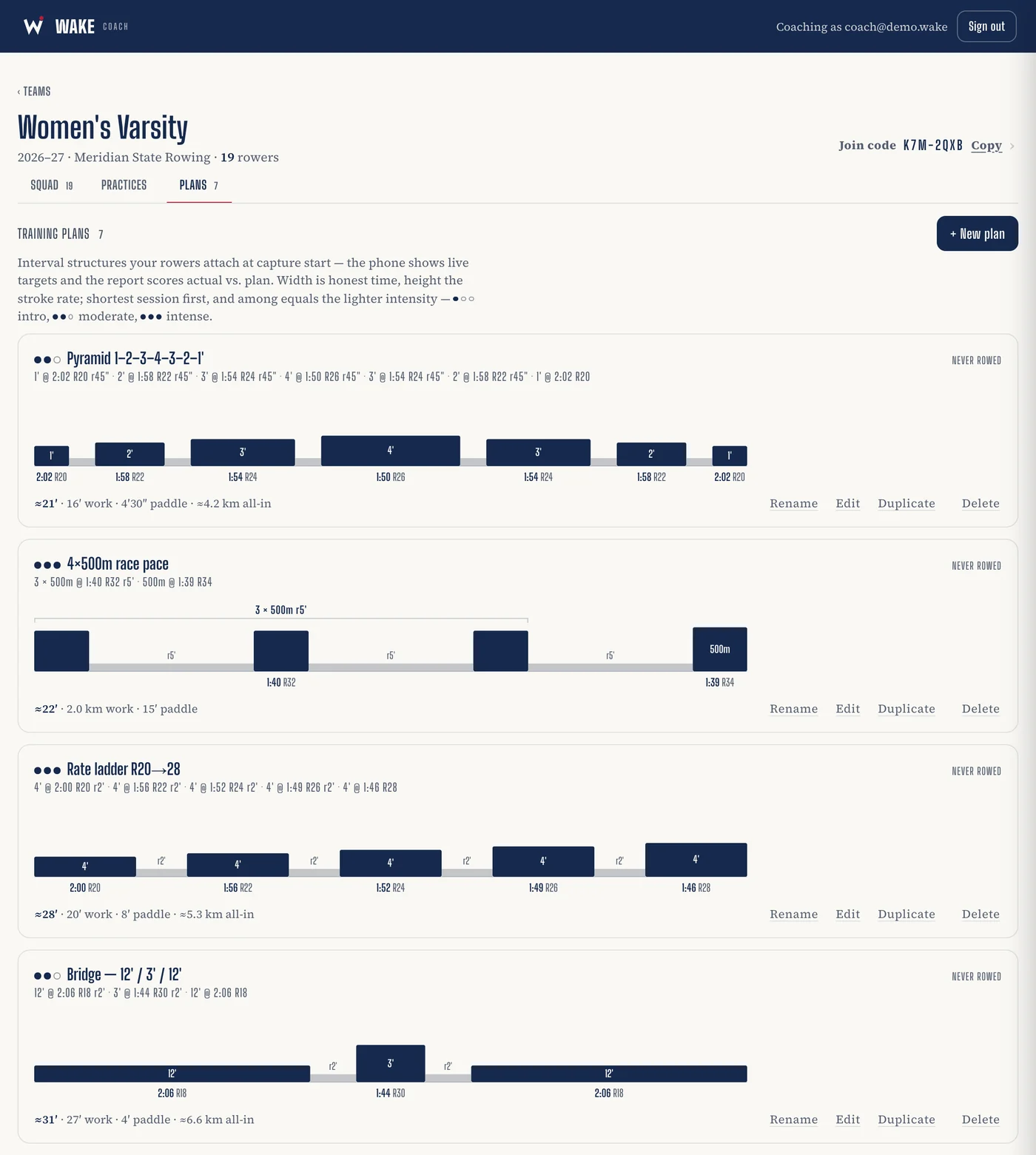
A plan is one strip. Width is real time, so a forty-minute session is visibly twice a twenty. Height is stroke rate, on the same scale for every plan in your book. Rest is drawn at its true width, because rest is part of the session. You do not read the book. You recognise it: a pyramid steps up and back down, a bridge is two long spans and a burst, a ladder climbs, race pieces are a picket fence over wide rests.
You file a session as intro, moderate or intense. It is a word you choose, never a number Wake works out — and it carries onto the plan book, the practice sheet, your rowers' phones and the report.
The book sorts by length, on the desk and on every rower's phone alike, because what a coach scans a list against is what fits this morning's water slot.
Seven days across, each with its session drawn at a glance — and the empty days stay in the grid and say so, because the gaps are part of the rhythm.
The boating
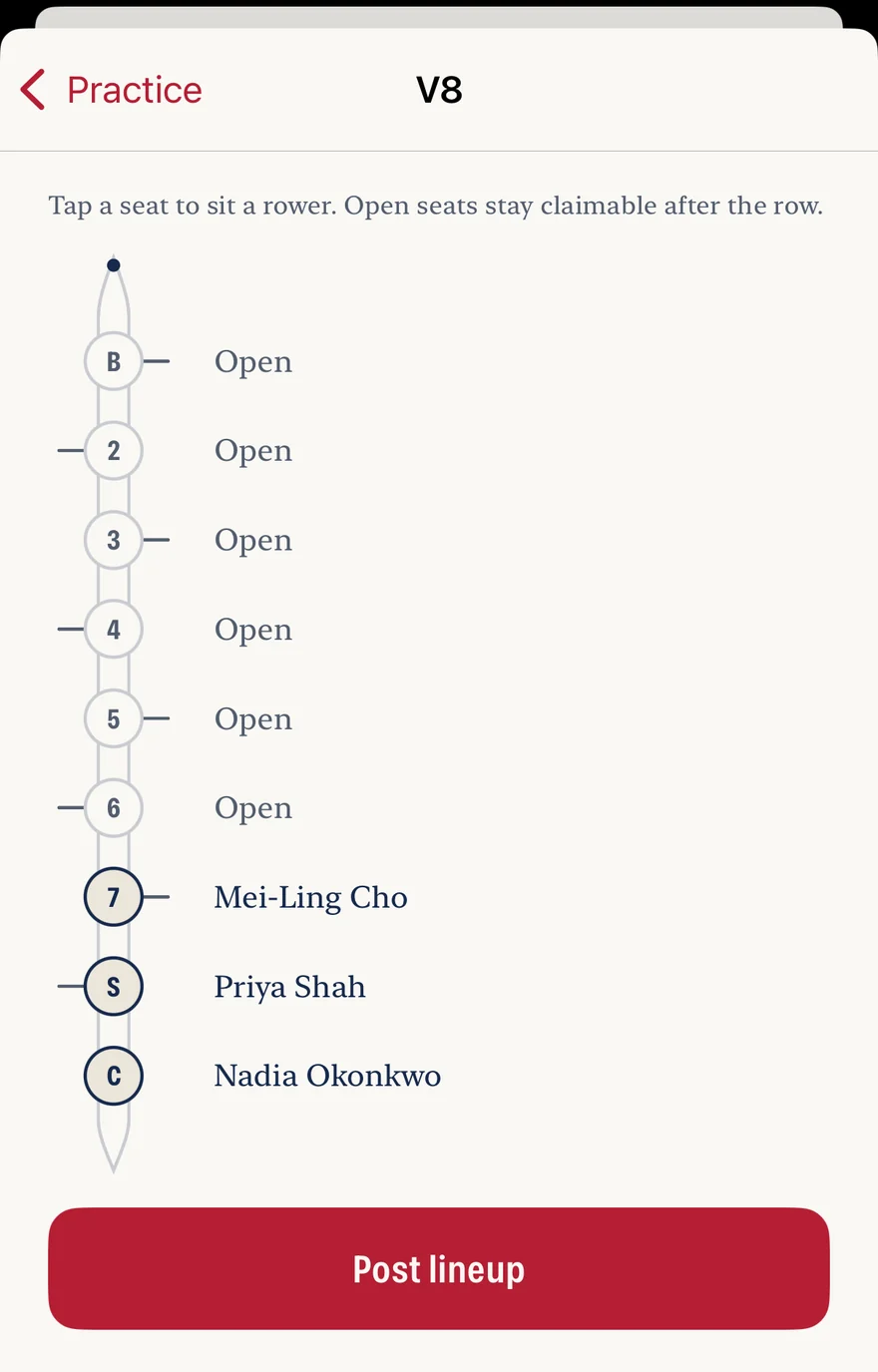
Open a boat and it draws as its seats. Tap a seat, pick a rower. On an empty spine, one tap seats last practice's crew — the last crew that actually went out in a boat of that name and class, not whatever template you copied — and anyone who has since left the squad comes back as an open seat, and it says so.
Seat someone already down in another boat of the same session and Wake will not stop you, because coaches move people. It sinks that rower to the bottom of the picker and names the boat currently holding them, so the classic she's-in-both-boats is caught before you post, not at the dock.
It is a draft until you post it. Thursday's seat race can be boated on Tuesday night without the squad reading over your shoulder. Post it, and each rower's phone shows them their own seat and only their own.
If you would rather it went in the group chat, one tap turns the whole practice into plain text: every shell, the seat carrying its phone, the workout, and the exact line to tap at the dock — the same sentence the app says to them there.
And the 05:40 dock swap does not need a laptop. Change the title, the time, the workout, the boats and the crews from the phone in the car park. A boat that has already rowed cannot be quietly deleted: its recording is the record.
While they're out
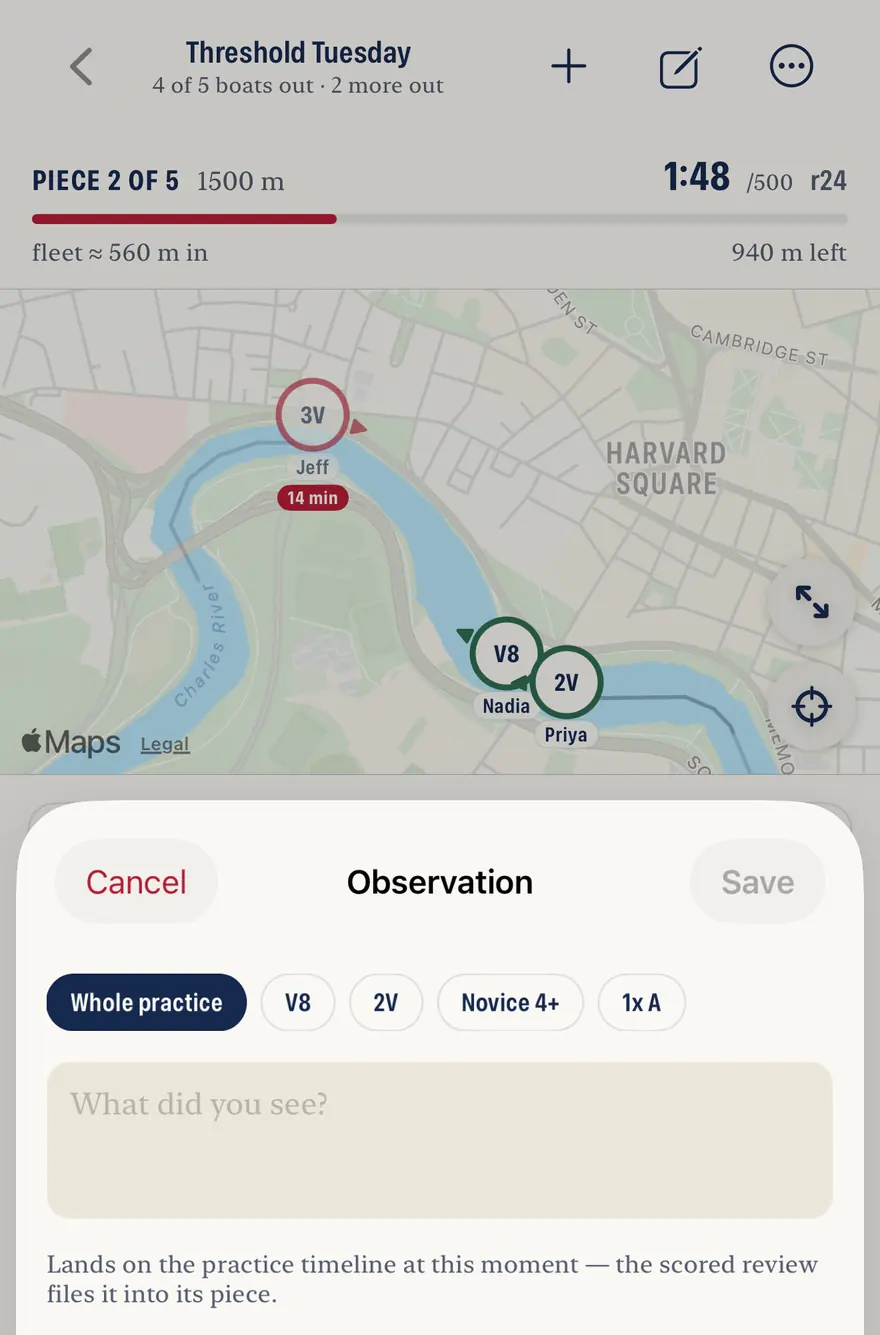
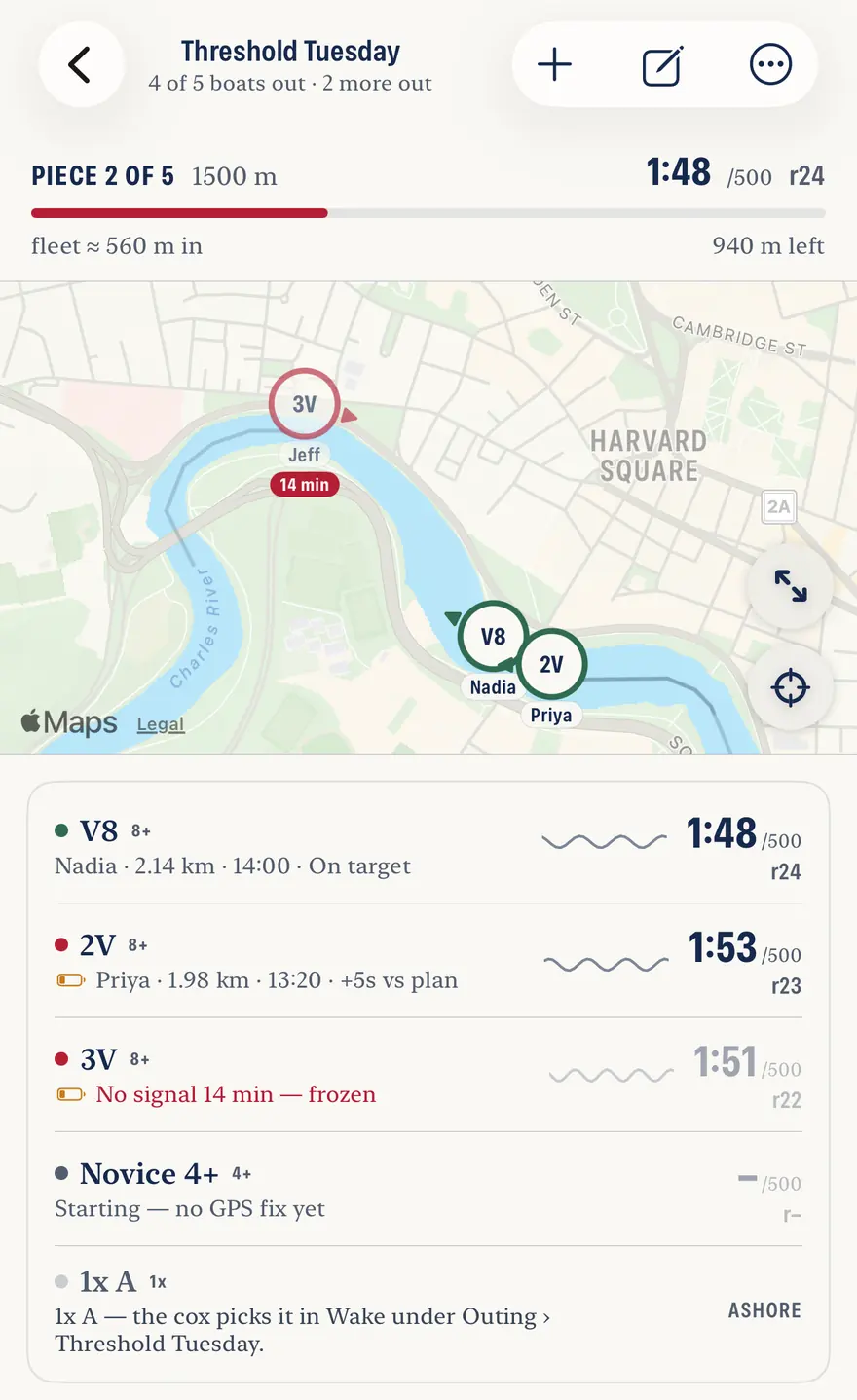
Your phone shows the piece the fleet is on, the water with every boat where it actually is, and the fleet as one column — a row per boat, its speed trace on a single shared scale, and the split aligned down one edge. A flatter line simply is a slower boat. No arithmetic.
Because every crew is rowing the workout you set, each boat carries a verdict rather than just a number: on target, or five seconds down, judged against the piece that boat is in and not the fleet's. You see the crew going backwards before the piece ends, not on the drive home.
Call the swap as you call it across the water. A note or a seat race taps into the boat's own card and is stamped at that moment — and afterwards the review files it into the piece it fell in, so what you saw and what they rowed are read together.
A silent boat dims and says "No signal for 14 min", and its pin marks where the phone stopped, not where the crew is. No screen here ever shows you an old number as though it were now.
Drag back and re-watch the start of a piece, every boat riding its own track on one clock with the order re-ranking as the field moves. Then tap LIVE to come back to now.
When a phone really is gone, mark the boat ashore and its row closes at its last real fix, not at the moment you noticed. If the phone was only in a dead spot, the row reopens by itself when the rowing lands.
The erg room
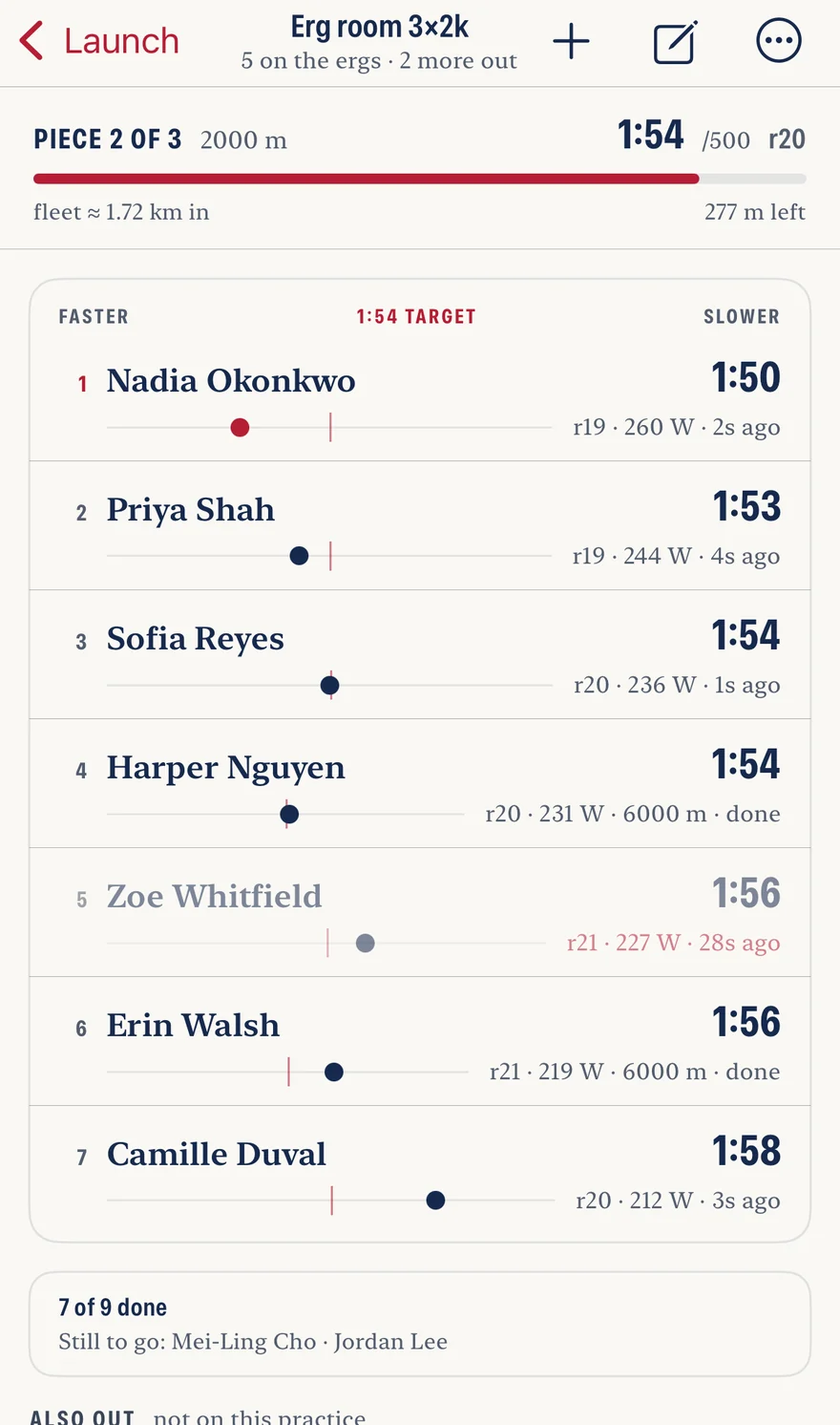
Winter is the other half of the year, and it is the half a launch-shaped tool has nothing to say about. An erg practice in Wake is not boats: it is the room. Every athlete who has joined is a mark on one shared split axis, fastest to the left, with the target split you set drawn as the rule — not the room's median, which flatters whoever turned up.
Every split, rate, distance and watt is the erg's own number, read off the monitor — not something the phone worked out. Beside each athlete sits their drag factor, which is the read you cannot make from across a room, and the one number that silently invalidates a comparison between two people on paper.
A lane that stops reporting says so rather than sitting frozen on a stale split. Heart rate reaches you only where that athlete has turned on sharing for your squad.
And for a session you set for the day rather than ran in the room, the practice simply says "14 of 19 done" and names the ones still to go — whether they pulled it at six in the morning or at nine at night.
When they're back
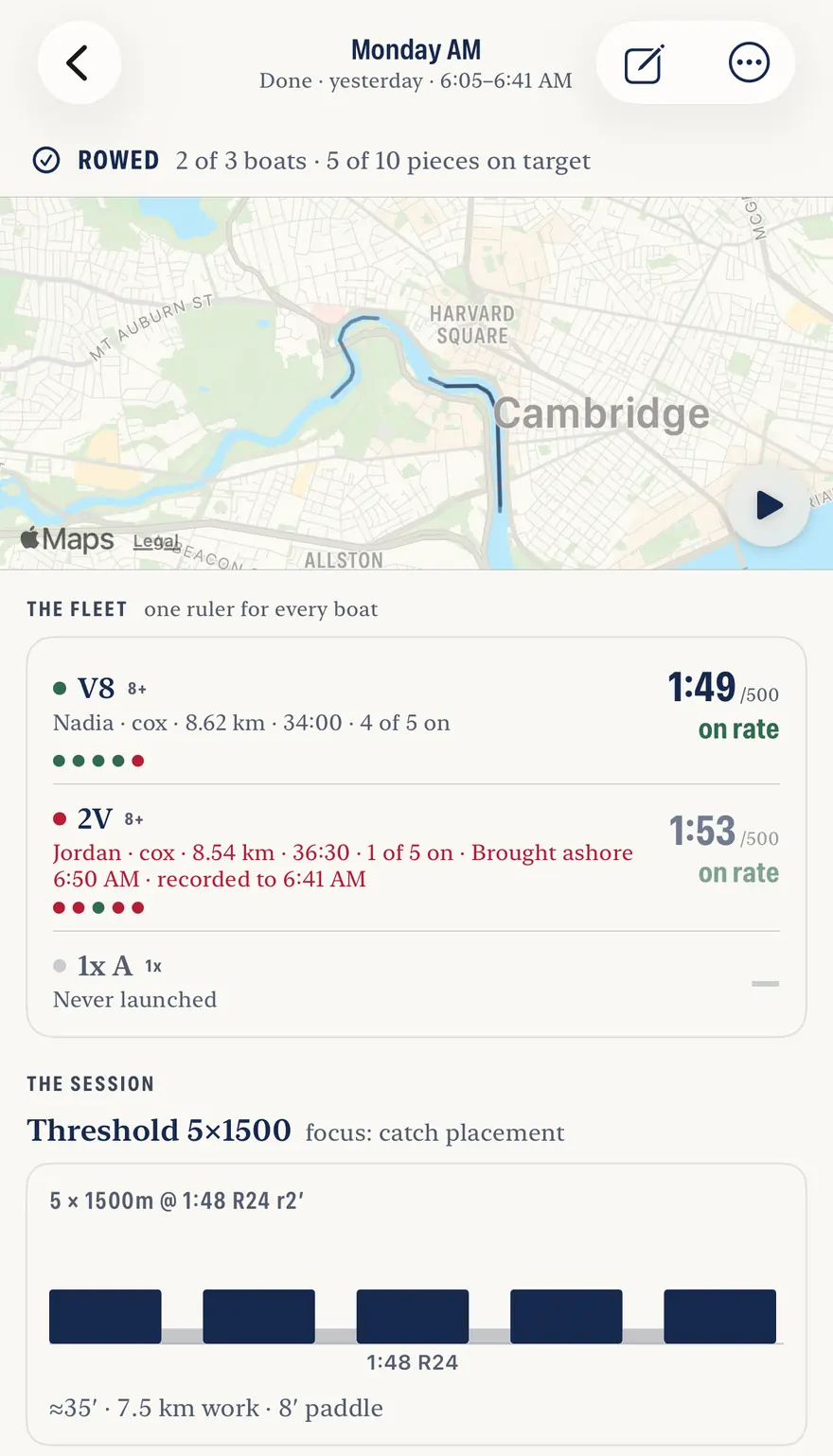
By the time the trailer is loaded the practice is already written up. Every boat is drawn on one shared speed scale and one shared clock — first boat off the dock to last boat in — so two crews that launched ten minutes apart still line up, and a longer row genuinely looks longer. Each boat carries its crew inside the row and a verdict under each piece. Five of ten pieces on target, and which five.
Two crews, the same set, the difference against the plan in every cell: whether the 2V went backwards in the third piece is read on one grid, not by flipping between two boats' numbers.
A seat race gives you a margin — each boat's average split over the complete pieces before and after the swap — with the plain warning that the verdict is only as fair as the water was.
And the record refuses to flatter you. A practice nobody ever launched reads "Never launched — 3 boats posted, none bound", and it will not state a fraction until every boat that did row has been scored.
Across the season
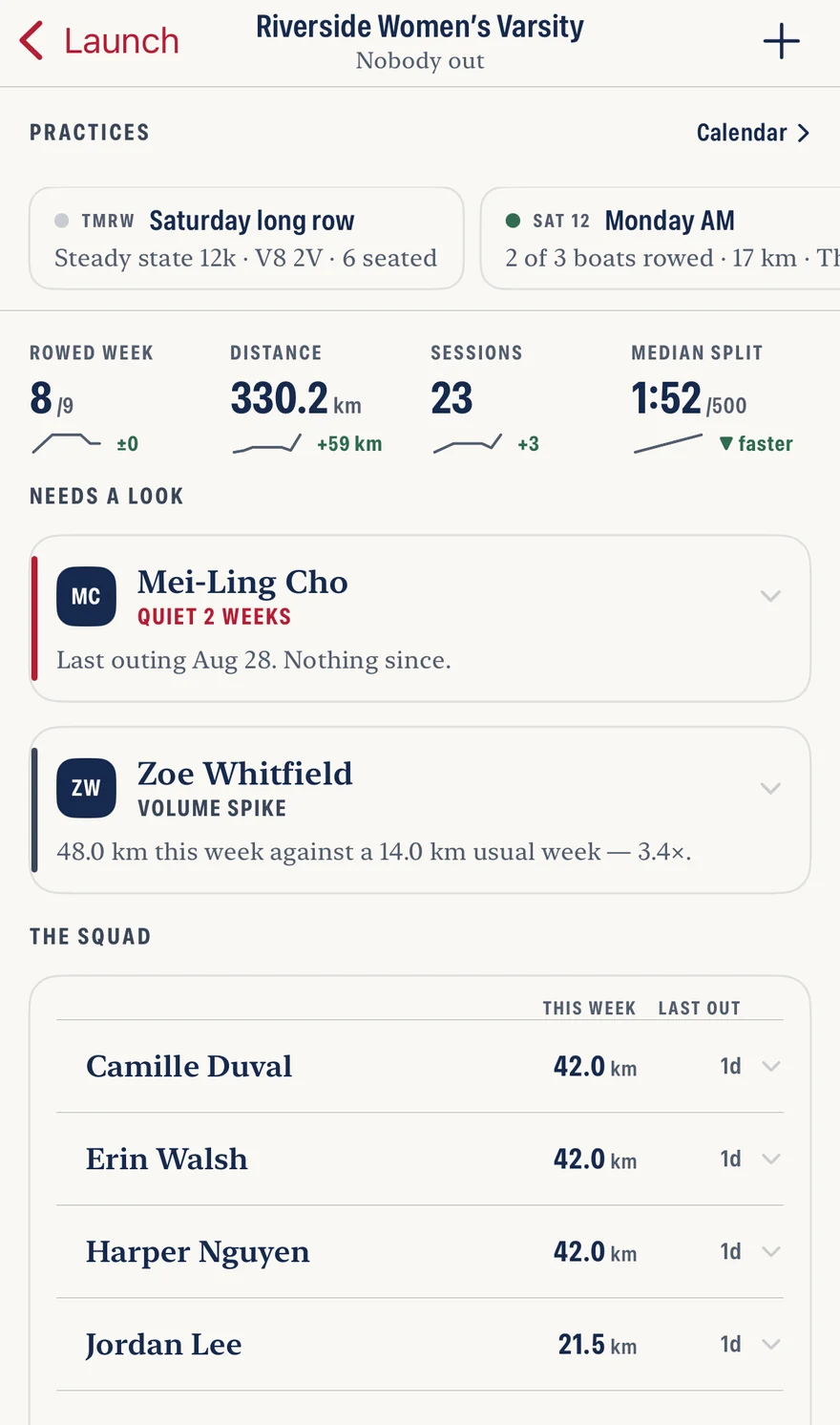
The squad report opens by naming the rowers to speak to this week, and the number that made it fire: "Last outing 4 Sep. Nothing since." A volume spike measured against that rower's own usual week, not against the squad's. It is not a ranking. It is a list of people to talk to, which is a different thing and the more useful one.
Underneath it: how many of the roster rowed, how far they went, how many sessions, and the squad's median split — each with its eight-week line and the change on last week. A week nobody rowed is drawn as a gap, not as a line through it.
Every practice keeps its lineups, bow to stern, read back beside what that boat actually did. So "who was in the four that went well in March" is a question the record answers, rather than one your memory has to.
Every comparison Wake draws is your crew against their own history, your squad, and the plan you actually set. Never against a club they have never met.
What you don't have to buy
One iPhone per boat, not one per rower. The cox opens Wake, the practice you posted is already on the screen, and the button reads Start as V8. One tap and that shell is on your launch screen, carrying your workout.
Nothing to mount before a session and dismount after, nothing to charge overnight, nothing to hand out at the dock and chase back at the trailer. On the erg the same phone talks straight to the Concept2 you already own — no dongle, no cable, no hub.
A row needs a signal to start. After that it does not — fixes keep landing every second and go up when the phone next sees the network. Nothing rowed is lost to a bend in the river with no bars.
Make a squad and read out the seven-character code. Every rower who types it in puts themselves on the list. If the code ends up in a screenshot, mint a new one — everybody already on the roster stays on it.
Conducting happens on your phone, in the launch, where you already are. The program — the roster, the staff and which squads they see, the plan book, the season's reading — is a web page on a laptop or an iPad in the boathouse, with nothing to install and nothing to ask your IT department for.
Your ergs, your boats and whatever units you already own stay exactly where they are. There is nothing to rip out and no data to migrate: a squad is rebuilt by reading one code aloud.
What the athlete keeps
A rower joins your squad by typing your code, and that act is the consent. You see the outings they tag to the squad, including every row done in a practice you set up. Anything untagged stays theirs.
Heart rate is a separate switch that starts off, per squad — and turning it off hides it again in your coach views, on rows already rowed. Leaving the squad takes one tap: nothing new reaches you from then on, the rows they already tagged stay with the squad as its season, and their heart rate is hidden on those too.
None of it is ever gated by whether the program has paid. Consent, leaving a team and erasing your data sit below the licence, not behind it — which is also the reason a coach can ask an athlete for this and expect a yes.
One more line worth saying plainly, because a coach has been sold the opposite before: Wake shows you what a crew did — split, rate, rhythm, the line they steered. It does not tell you what they are doing wrong. That is still your eye, and it is meant to be.
Getting started
Your first program gets roughly six weeks with everything switched on, so you can judge it in a real week of training rather than from this page.
Free, always
Licensed program
What a licence costs
Priced by the size of your roster, never by features. Every licensed program gets the whole product — the live launch view, every squad, every coach. These are list prices; a licence is quoted for your program, and the quote states the season it covers. Invoiced annually; we'll take a purchase order.
Founding programs
We're working with a small number of founding programs through the 2026–27 season at a founding rate, chosen by fit. Places are limited and offered at our discretion.
An athlete never pays to take part. Anything you prescribe, and anything the team consents to, works on the free tier — the licence buys your view of the squad and your athletes' personal premium features, never their participation. Consent, leaving a team and erasing your data are never gated by a licence.
Talk to us
How many squads, how many athletes, and what your week actually looks like. We'll set you up and stay close through the first fortnight.